3I/ATLAS
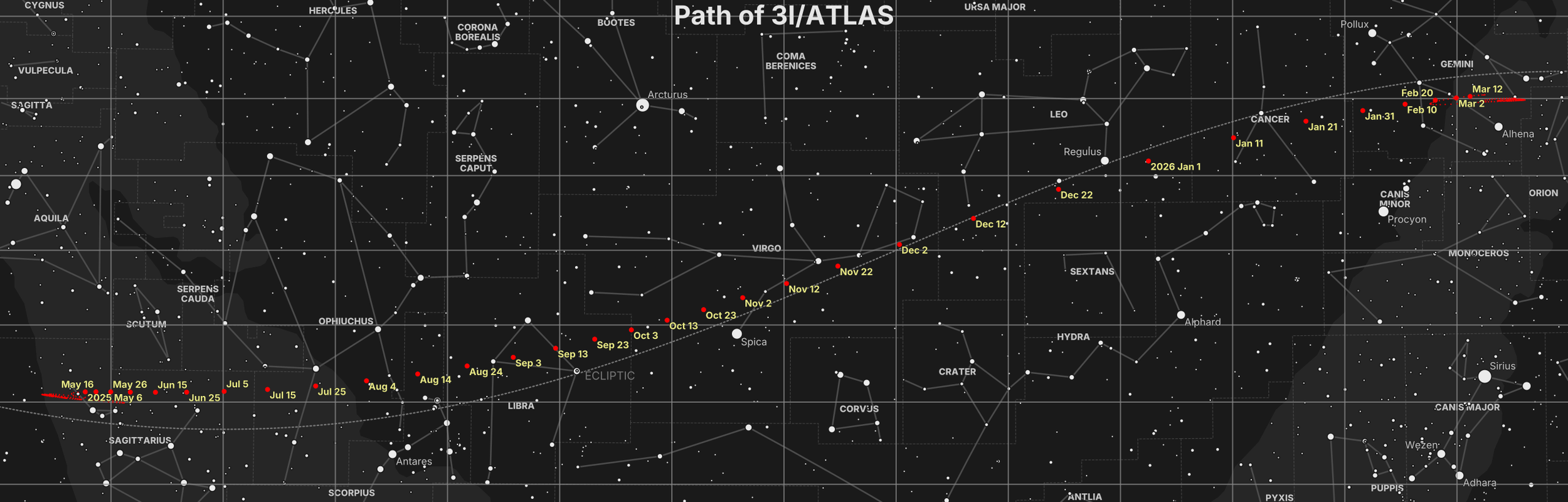
An alien spaceship, a cosmic seed, or an interstellar comet? On this new moon, December 19, 2025, 3I/ATLAS is passing closest to Earth during its travel through our Solar System. Composed of Water, Iron, Magnetite, and Carbon while off-gassing Nickel; this spacecraft defies our understanding of gravity and the orbital path around the Sun. As we approach the darkest night, on December 21, 2025, may we go inward and reflect upon the last year. Rather than resist the change, let us lean into it. Death is always incubating new life. After the Winter Solstice, light will begin to linger a bit longer each day. Perhaps new life will be bred from our interstellar friend.

Photograph by Joey Holdren
What is 3I/ATLAS
3I/ATLAS is the third confirmed macroscopic interstellar object observed passing through our solar system (after 1I/’Oumuamua and 2I/Borisov). It was first flagged on July 1, 2025 by the NASA-funded ATLAS survey in Chile and then rapidly confirmed with images.
Stats
Estimated size 1400 ft to 3.5 miles with 16.16 hour rotation period
When discovered it traveled at 137,000 mph
Pulled by the Sun’s gravity, its speed increased to 153,000 mph at its closest approach to the Sun (perihelion)
Experienced a 2-magnitude brightness surge as it neared the Sun
Characteristics, speed, color and direction are all consistent with what we expect from a comet
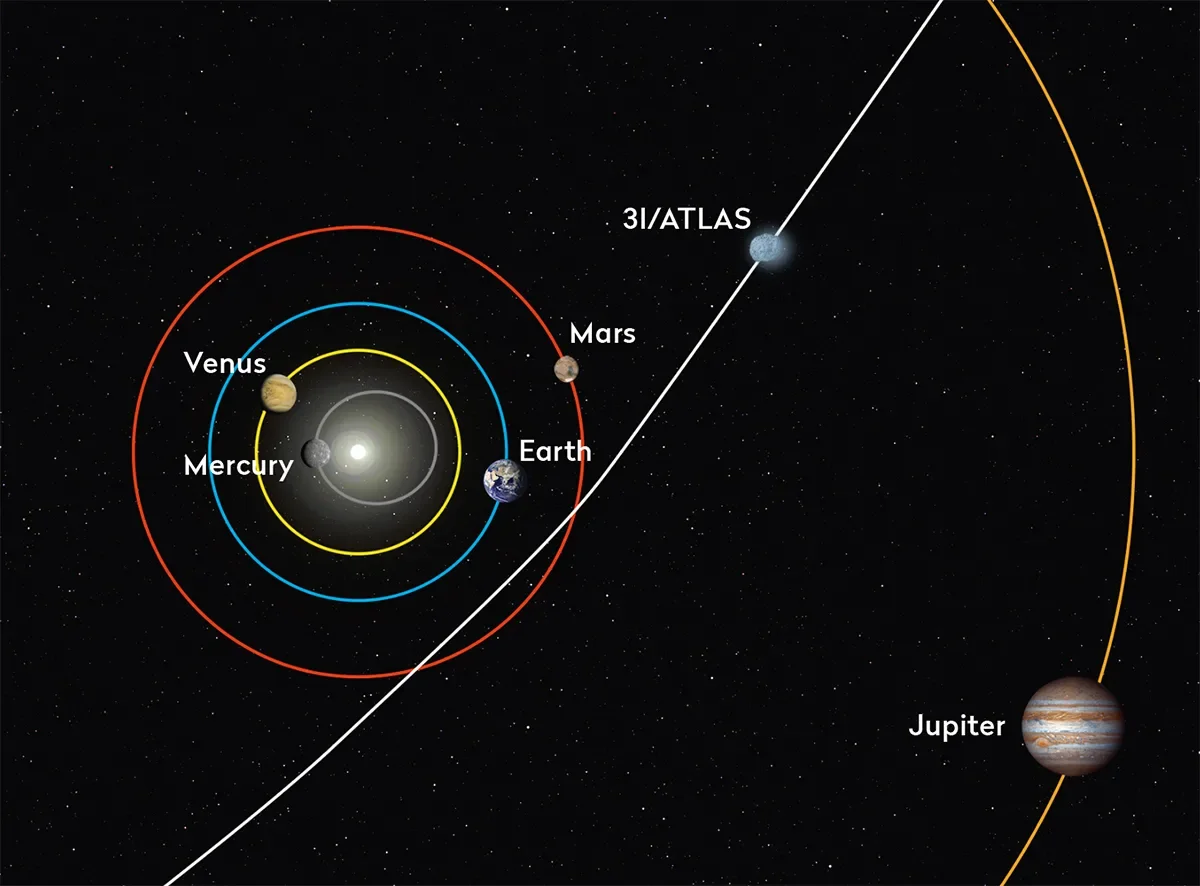
Trajectory + Orbit
The orbit is strongly hyperbolic (eccentricity ~6), meaning it is not gravitationally bound to the Sun and is consistent with an origin outside the solar system.
Early characterization reports perihelion (closest approach to the Sun) around ~1.36–1.37 AU, inclination ~175°(a near-retrograde path), and an inbound hyperbolic excess speed V∞ ~58 km/s.
Orbital solutions and official observing records are maintained through the Minor Planet Center (MPC), which published the initial circular with orbital elements and discovery/follow-up details.
Earth will orbit through the perihelion region of 3I/ATLAS March-April 2026
Activity
Most reporting from major observatories and agencies indicates clear cometary behavior:
Deep stacked images from facilities including CFHT and VLT resolve a compact coma, consistent with volatile-driven activity.
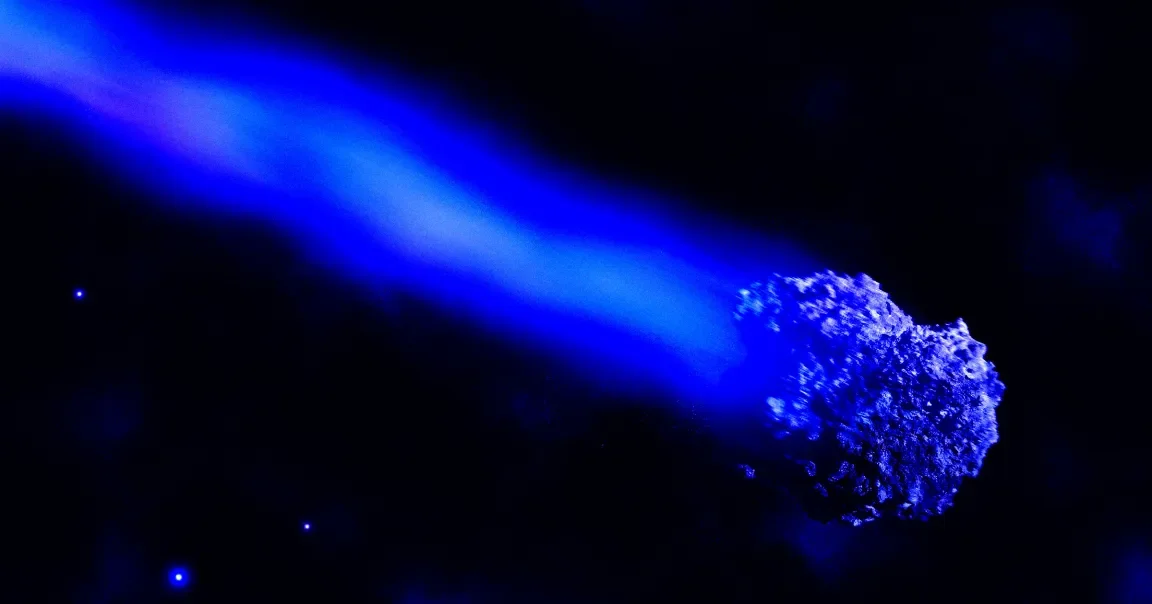
Hubble imaged 3I/ATLAS and describes a dusty envelope/teardrop-shaped cocoon around the nucleus—again consistent with an active comet.
ESA summarizes coordinated follow-up using multiple ground- and space-based assets (including Hubble and JWST, and high-energy observatories like XMM-Newton and XRISM) aimed at characterizing the object during its passage.
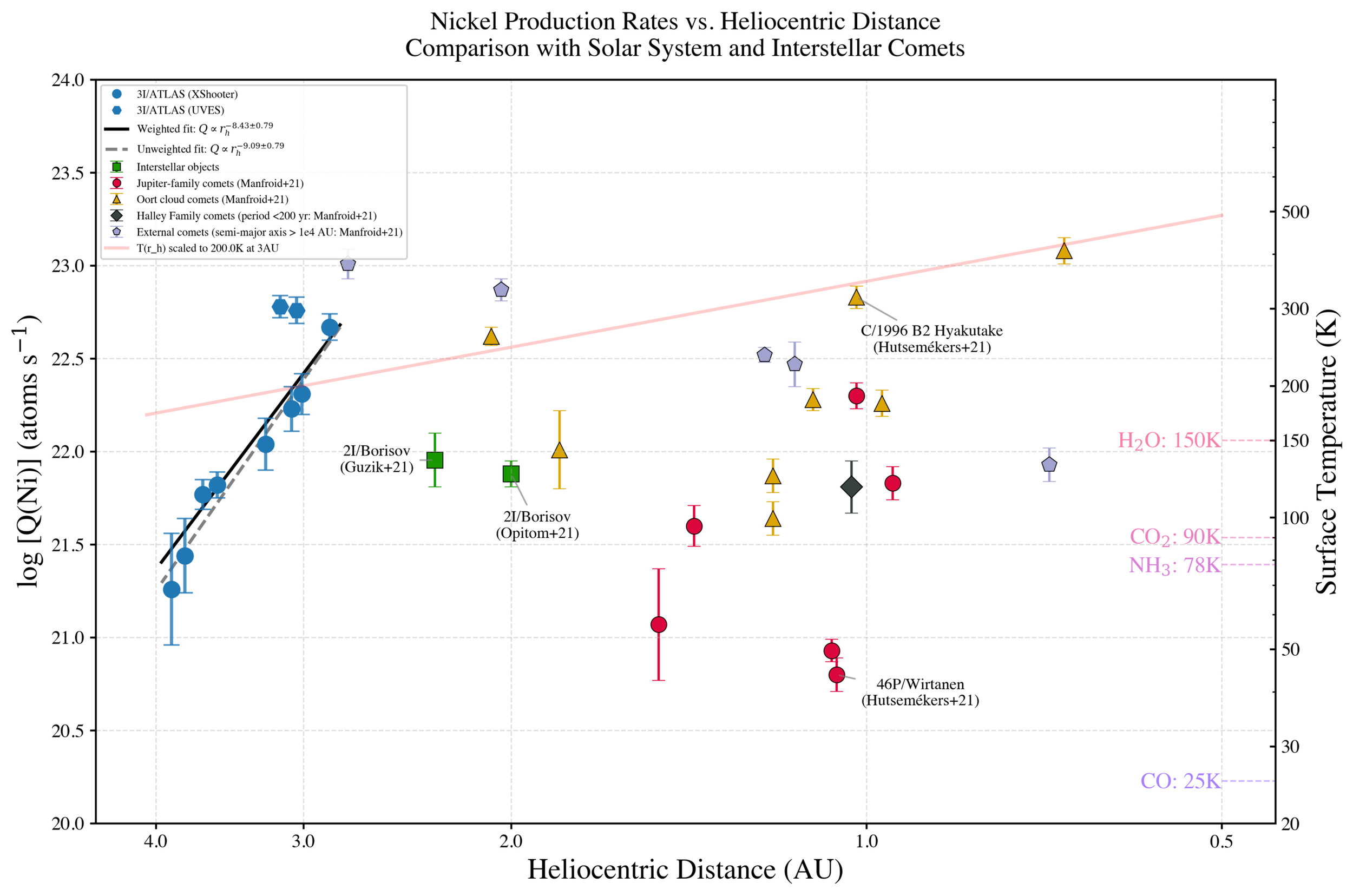
Anatomy
H2O
Iron
Nickel
Cyanide
Magnetite
Carbon
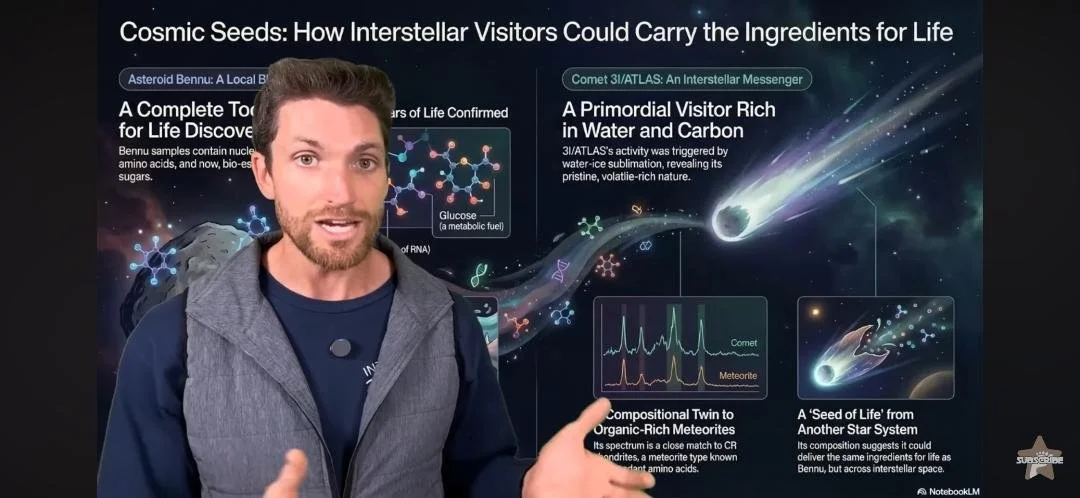
If it’s anything like the Meteor Bennu, it could contain complex sugars that are the building blocks of life. Ribose and Glucose. This would make it a “cosmic seed” for life.
Stefan Burns
SOURCES:
https://www.space.com/astronomy/comets/interstellar-comet-3i-atlas-wasnt-supposed-to-be-there-meet-the-astronomer-who-discovered-it
https://academic.oup.com/mnrasl/article/542/1/L139/8206197
https://science.nasa.gov/asset/hubble/comet-3i-atlas/
https://minorplanetcenter.net/mpec/K25/K25N12
https://arxiv.org/abs/2507.02757
https://www.esa.int/Science_Exploration/Space_Science/ESA_observations_of_interstellar_comet_3I_ATLAS
https://en.wikipedia.org/wiki/3I/ATLAS
https://www.discovermagazine.com/asteroid-bennu-samples-carry-mysterious-space-gum-sugars-and-a-ton-of-stardust-48378