Neither Light Nor Darkness
I recently encountered the Gaia hypothesis, developed by James Lovelock and further advanced with microbiologist Lynn Margulis. It proposes that life and Earth's physical environment form an interconnected system in which organisms do not merely adapt to their surroundings, but actively transform them. Through interactions with the atmosphere, oceans, soils, and climate, life participates in feedback processes that can either stabilize or destabilize the conditions necessary for its existence.
One of Lovelock's most compelling illustrations is Daisyworld, a hypothetical planet inhabited by dark and pale daisies. Dark daisies absorb sunlight, warming their surroundings, while pale daisies reflect sunlight, producing a cooling effect. As temperatures fluctuate, the relative abundance of each population changes. Under certain conditions, these opposing influences regulate the planet's temperature without conscious intention or centralized control.
What emerges is an equilibrium sustained not by the elimination of opposing forces, but through their interaction.
I was immediately reminded of Dion Fortune's The Mystical Qabalah, in which she challenges the division of existence into absolute good and evil. For Fortune, mercy and severity, creation and destruction, light and darkness are not necessarily enemies, but complementary forces whose relationship sustains the whole. Even virtue, when carried to excess, can become destructive. Mercy without discernment permits harm; severity without compassion becomes cruelty.
Like the shifting populations of Daisyworld, Fortune's image of the pendulum suggests that equilibrium is not a fixed condition, but a continual process of movement and correction.
“The equilibrium of the universe may best be likened to the swing of a pendulum rather than the grip of a clamp.”
—Dion Fortune, The Mystical Qabalah
Perhaps harmony is not achieved through the triumph of one force over another, but through their continual negotiation. Opposition is not necessarily an obstacle to overcome. It may be the very condition through which life, transformation, and evolution become possible.For Dion Fortune, equilibrium is not the absence of conflict, but the continual negotiation between opposing forces. Creation depends upon tension. Without resistance, there can be no movement, transformation, or growth.
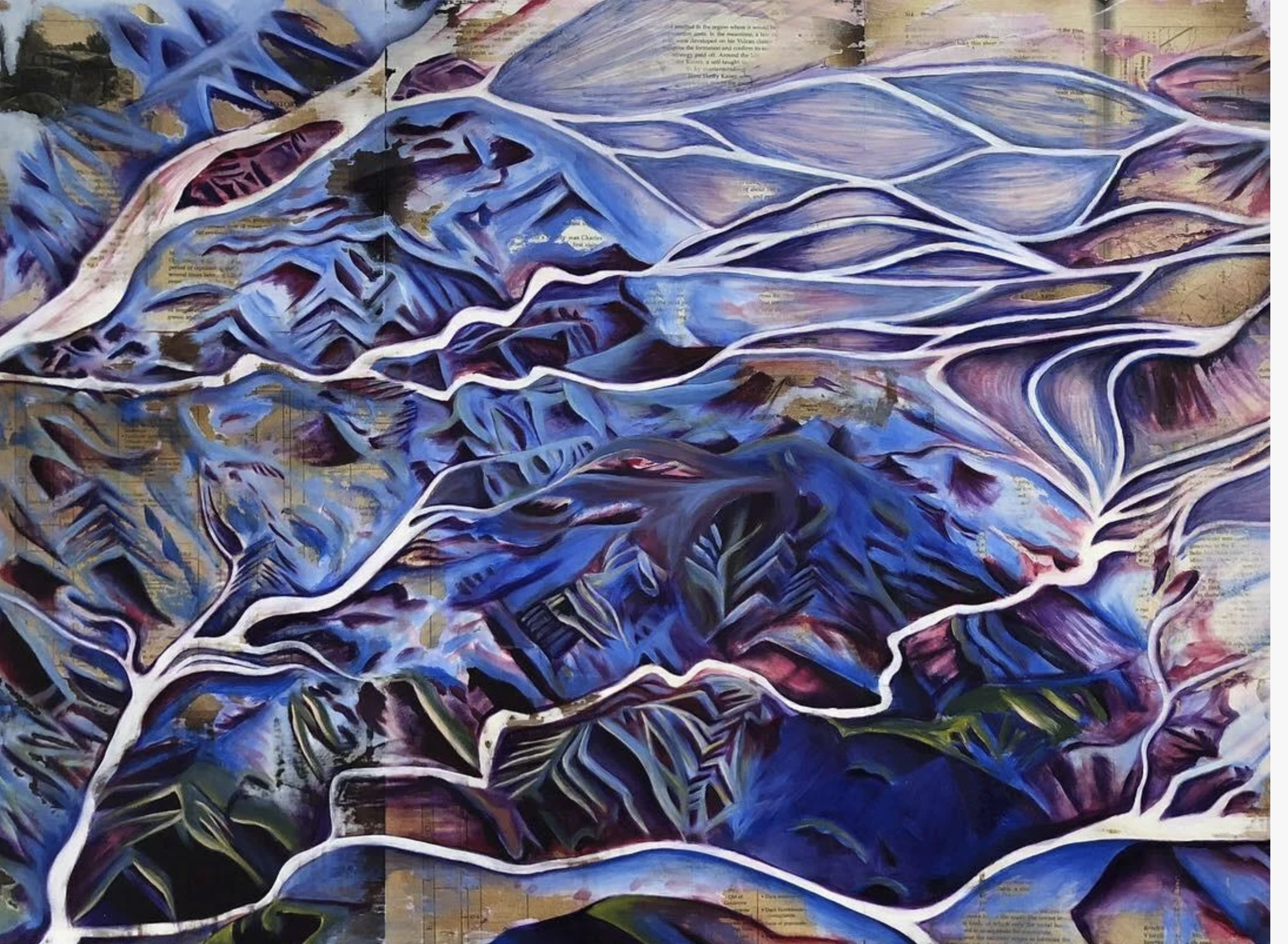
B.Penouilh, Earth Through Time, acrylic, paper and plaster on wood, 2019
Reference
Fortune, Dion. The Mystical Qabalah. (London: Ernest Benn, 1972), [297-304]
Lovelock, James E. The Ages of Gaia: A Biography of Our Living Earth. New York: W. W. Norton & Company, 1988.