Again-Walker: A Ritual for Living
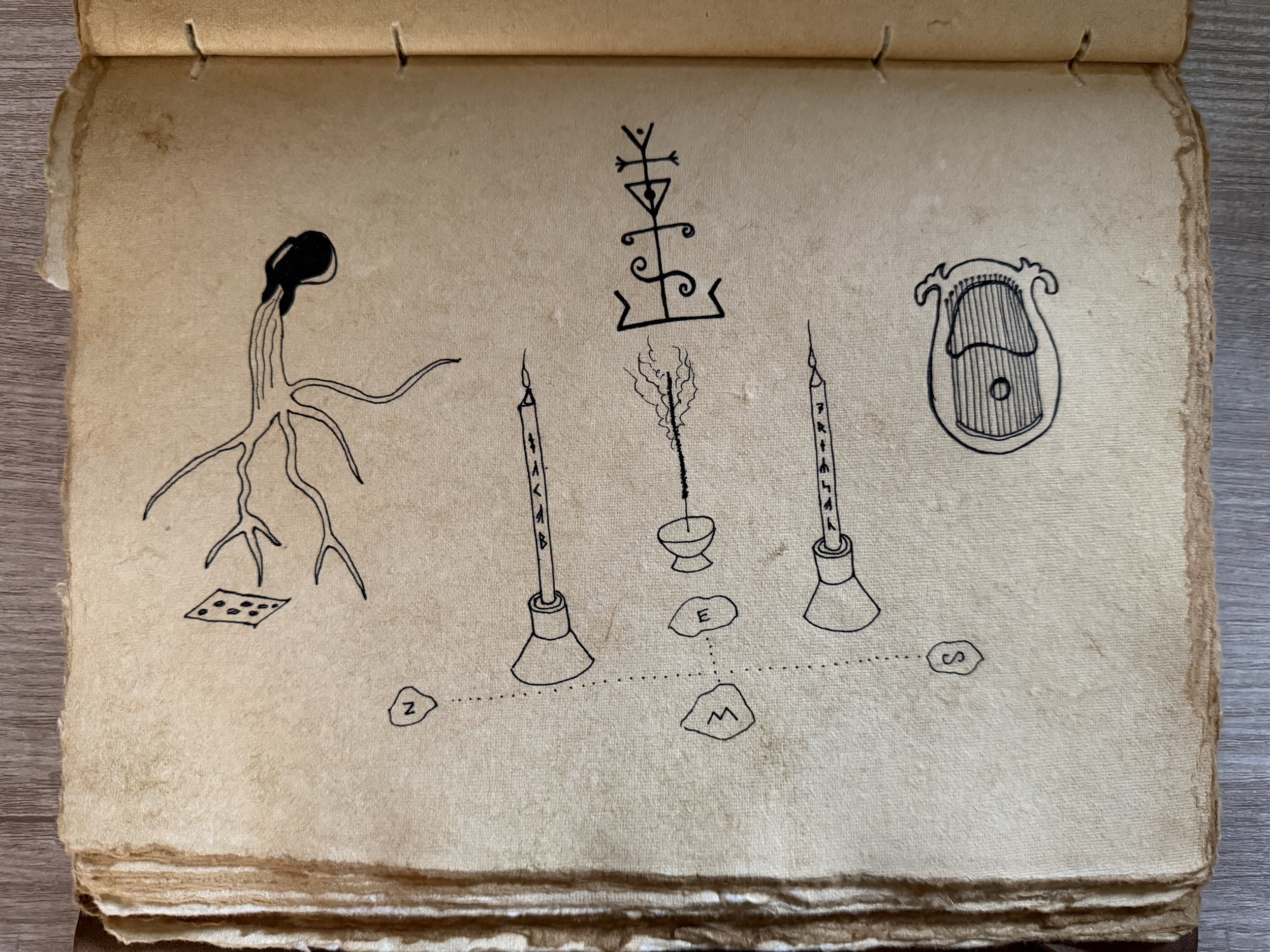
Loss and grief can embed themselves in the fibers of clothing, the grain of old cabinets, and the quiet corners of rooms where dust has accumulated undisturbed. Grief can settle into places as much as people.
If landscapes preserve evidence of ancient events and rivers carry the remains of distant mountains, perhaps the places we inhabit also retain traces of human experience.
During my travels, I encountered a heaviness in a space marked by multiple family tragedies. It reminded me of a ritual I learned a few years ago while studying runic traditions.
I performed the ritual as an act of compassion, honor, and release. The experience left me reflecting on how rituals offer structure for processing difficult emotions that accompany death.
In Old Norse belief, an aptrgangr ("again-walker") was a revenant whose unresolved death was thought to bind them to the world of the living. Medieval sources describe these beings as lingering after death, their presence entwined with violence, grief, or unfinished obligation. Some later Scandinavian traditions held that such spirits lingered for the span of life they had been denied by an untimely death.
From the moment I entered the space, I noticed a series of disturbances that I quietly set aside rather than attempt immediate interpretation. As I later learned more about the history of the deceased, the Old Norse tradition returned to memory in an unexpectedly meaningful way. I sat with that connection for some time before asking permission to perform a ritual. I believe permission establishes respect where assumption risks causing harm. Even if that principle functions only as a symbolic posture, it shapes the ritual with humility rather than authority.
In nature, stagnant water can become depleted of oxygen, while flowing water continually renews itself through movement and exchange. Ritual may serve a similar function for grief. Left unspoken, sorrow can settle into memory, relationships, and even places.
Ritual invites movement where there has been stillness.
Whether one perceives what remains as spirits, memories, or the lingering weight of grief, it deserves acknowledgment.
Ritual offers a way to do that.
Medieval Scandinavians sometimes responded to feared revenants through dramatic interventions that included exhumation, decapitation, or reburial—practices rooted in a worldview very different from our own. These actions reflected not cruelty but a sincere attempt to restore social and spiritual order within the community. While those methods belong to another time, the underlying impulse remains recognizable: to restore peace for both the living and the dead. Modern ritual can preserve that intention symbolically rather than literally.
Drawing from a modern reconstruction inspired by Old Norse tradition, I carved the names into white candles using runes. Four river stones marked the cardinal directions while lavender smoke carried the evening air. I spent hours with wine and the lyre, letting music become another form of prayer. The following morning, I buried the remaining wax, incense ashes, and stones on the west side of a local cemetery. Alongside them I planted solar seed paper and watered the earth as a final gesture of renewal.
The following day unfolded through a quiet sequence of moments that felt deeply meaningful. I cannot say whether anything beyond myself had changed. I only know the room felt different.
The ritual did not answer every question. But it gave grief somewhere to go.
Across cultures and centuries, people have turned to ritual when language alone proved insufficient. Whether understood as spiritual practice, symbolic action, or psychological process, ritual creates movement where grief has settled. It cannot erase loss, but it can acknowledge it. Sometimes acknowledgment is enough to transform both the places we inhabit and the people we become.
Perhaps this has always been one of ritual's oldest functions: not to explain death, but to restore relationship—with place, with memory, with community, and with ourselves.
Selected References
Davidson, H. R. Ellis. The Road to Hel: A Study of the Conception of the Dead in Old Norse Literature. Cambridge University Press, 1943.
Grettis saga Ásmundarsonar, chapters 32–35 (Glámr episode). See Bernard Scudder (trans.), The Sagas of Icelanders. Penguin Classics, 2000. (Alternatively, Denton Fox & Hermann Pálsson, trans., 1974.)
Hastrup, Kirsten. Culture and History in Medieval Iceland: An Anthropological Analysis of Structure and Change.Oxford: Clarendon Press, 1985.
Lecouteux, Claude. The Return of the Dead: Ghosts, Ancestors, and the Transparent Veil of the Pagan Mind. Inner Traditions, 2009.
Simek, Rudolf. Dictionary of Northern Mythology. D. S. Brewer, 1993.